A join represents a lead; a deposit represents revenue. Many Telegram funnels report the first and lose the second, because by the time someone pays there is no browser session left to measure. This guide explains how to keep the deposit attributed to the original click, and how iGaming and betting funnels read cost per first-time deposit (FTD) by ad.
Written by the Tellmetric team and checked against the product. Updated .
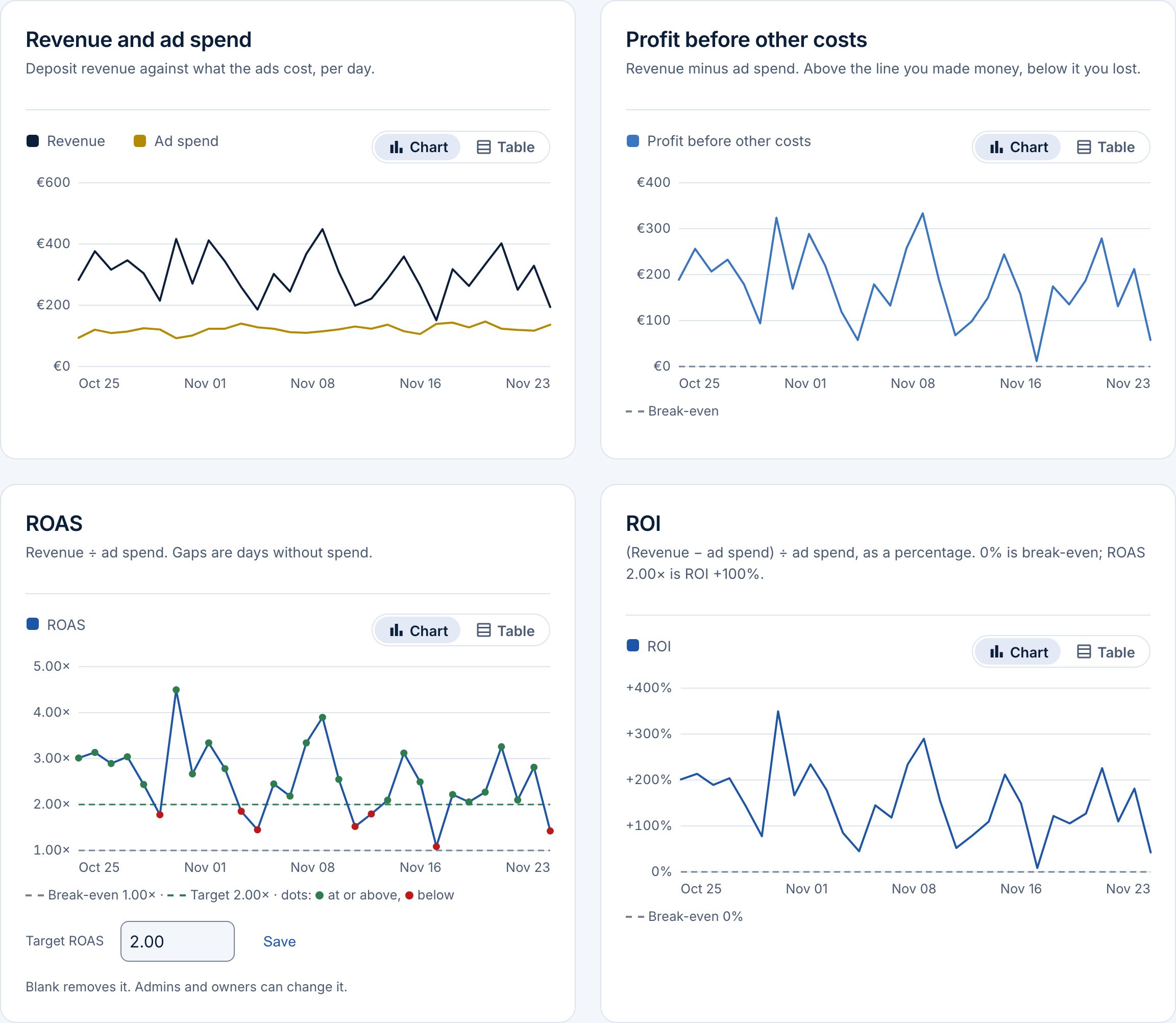
Revenue, ad spend, profit, ROAS and ROI per day, built from the deposits you report. Shown with demo data.
Why deposits are difficult to attribute
In a web store, the purchase is recorded on a confirmation page by the pixel. A Telegram funnel has no equivalent page. The deposit may be recorded in a broker's back office, a casino or bookmaker's platform, a payment provider, a Stars invoice inside the bot, or a spreadsheet maintained by a sales team, and it usually occurs well after the ad click. Unless the click id has been retained throughout, the deposit cannot be assigned to the campaign that produced it.
The gap also affects optimisation. A campaign that only ever reports joins teaches the ad platform to find people who join. Some of them will deposit, many will not, and the platform has no way of telling the two groups apart. Reporting the deposit, with its value, is what allows a campaign to optimise for revenue rather than membership.
What must be recorded
The click id issued at redirect time, together with its campaign, ad set and creative.
The Telegram identity that later joined or sent a message, linked to that click id.
The deposit itself: amount, currency, transaction id and time.
Any identifier known to the payment system, such as an email address or phone number, hashed for matching.
Each item has a different source. The click is known only at the moment of the redirect, the Telegram identity only to the bot, and the deposit only to the payment system. Deposit tracking is the work of keeping these three records joined. Once a person has joined through a single-use invite minted for their click, they are known by their Telegram account and nothing expires on Tellmetric's side.
Four ways to report a deposit
Tellmetric accepts deposits through several channels, so you can choose the one your payment setup already supports.
Postback URL. The standard server-to-server format used by affiliate trackers such as Keitaro, RedTrack and Voluum: clickid, status, payout, currency and txid. It suits any platform or tracker that holds the Tellmetric click id and can call a URL when a deposit is made.
Event API. A POST to /track/event from your own backend, authenticated with your secret key. You can send the depositor's Telegram user id instead of a click id; the deposit is then attributed to the click behind that person's most recent bot start within the previous 30 days. This is the route when the operator does not hold the click id but your bot knows who the person is.
Hosted form. If you have no platform that can send a postback, a Tellmetric form lets the customer confirm their deposit. When a tracking link points at the form, the click id is added automatically, so the submission is credited to the right ad.
Telegram Stars. A Stars payment received by your bot is recorded as a purchase when the invoice payload carries the click id. Stars amounts are converted to US dollars before delivery, since ad platforms accept only ISO currencies. Telegram Mini App attribution covers in-app payments in more detail.
The postback is one request per deposit. A Keitaro, RedTrack or Voluum style template looks like this, with the tracker filling in its macros:
codePostback URL template
GET https://www.tellmetric.com/postback?clickid={clickid}&status=ftd&payout=100¤cy=EUR&txid={transaction_id}&api_key=…
status is one of lead, contact, reg, dep, ftd or sale; txid keeps a repeated postback from counting twice. The exact URL with your key, and ready templates for Keitaro and RedTrack, are on the developer page.
Step-by-step setup
Place a tracking link behind every ad so each click receives its own id before the visitor reaches Telegram.
Send the visitor into Telegram through that link. The bot records the join or first message against the click id.
Create a secret key on the API & postbacks page. Your platform sends it in an Authorization: Bearer header, or as api_key in the URL if it cannot set headers.
Give your deposit source (a tracker, CRM, operator or payment gateway) the postback URL with the click id, status, payout, currency and transaction id filled in by its own macros, or call the event API from your backend.
Add the customer's email or phone number to the postback if your platform has them. Tellmetric hashes them before storage, and they raise match quality on Meta.
Send a test deposit and check the response: it states whether the click was matched and which identifiers the event carries.
On postback, Tellmetric looks up the click, inherits its identifiers and sends a Purchase event with value and currency to the ad platform.
The transaction id is part of the event id, so a repeated postback for the same deposit is ignored, while a second deposit from the same person is counted.
Illustrative example
The following sequence is illustrative. A Meta ad sends a visitor through a tracking link on 3 March. The link issues click id c_8Xk…, records the fbclid and UTM campaign, and opens the bot. The visitor joins the VIP group the same day, which Tellmetric reports as a registration. On 14 March the broker's system calls /postback?clickid=c_8Xk…&status=dep&payout=200¤cy=EUR&txid=90412. Tellmetric matches the click, attaches the hashed Telegram id and the customer's hashed email, and sends a Purchase event worth €200 to Meta under the original campaign. The deposit is attributed correctly eleven days after the click.
First deposits (FTD), repeat deposits and refunds
Not every deposit is equal. A first deposit marks a new customer; later deposits measure how valuable that customer becomes. The postback grammar distinguishes them with status=reg for a registration, status=ftd for a first deposit and status=dep for any later deposit. Ad platforms have no FTD event; what they optimise towards best is a Purchase with a value, so both ftd and dep are sent as Purchase with the payout as value, and the original status is kept on the event.
The payout can be the deposit amount or the commission you are paid. Choose one and keep it, because this is the value Meta and TikTok will optimise towards, and mixing the two makes return on ad spend meaningless.
When the same person deposits again, Tellmetric marks the event as coming from a returning customer and refers Meta to the first purchase. Refunds and chargebacks can be reported with status=refund or status=chargeback. They are tied to the original purchase and recorded for your own reporting, but never sent to an ad platform as a conversion.
If your workspace holds deposits for review, each deposit waits on the Deposits page until a team member approves or rejects it, and only approved deposits are delivered. A deposit that has already been delivered cannot be withdrawn from an ad platform, so a mistaken one is corrected by recording a refund.
iGaming and betting funnels: cost per FTD
An iGaming or betting funnel on Telegram is the longest deposit funnel there is to track. Most follow the same shape, whatever the brand:
The ad, on Meta, TikTok, Google or Telegram Ads, pointing at a channel, a bot or a short landing page.
A free channel with signals, tips or predictions. The person joins and reads for a while.
A VIP step, a private group or bot conversation where the offer is made: a link to register with the operator, sometimes a bonus code.
Registration on the operator's site, outside Telegram.
The first-time deposit, the event the campaign is bought against. It can arrive minutes or weeks after the click.
The question the media buyer needs answered is not how many clicks, but cost per FTD by ad, and which ads bring depositors who stay. Each step hands the person to a different system, and attribution only works if the click id survives every hand-over.
Carrying the click out to the operator
Inside Telegram, the single-use invite ties the member to their click. The break usually happens at the registration link. A plain operator link posted in the VIP group carries no click id, so the postback that follows arrives with an empty one and the FTD lands nowhere.
The fix is to post an offer link instead: a "web page or offer" tracking link created on the Links page, pointing at the operator's registration URL. It is filled per person with {clickid}, {utm_*} and {sub1} to {sub9}, so the operator's page receives the click id in its own parameter, for example ?sub_id={clickid}, exactly as it would from a website. On registration and on the first deposit, the operator's or network's tracker calls the postback URL with that id, the status and the payout, and the FTD is credited to the ad that started the chain. Telegram postback tracking covers the postback mechanics in full.
The operator needs nothing beyond a postback URL in the clickid, status, payout, currency and txid format that networks already send to Keitaro, RedTrack or Voluum.
Retention: the number before the FTD
In iGaming the FTD is rare and slow; a campaign can run for a week before the first one lands. Two earlier numbers tell you whether a creative is worth keeping until then:
Cost per join: spend divided by real joins through your links, shown beside each row once spend is imported from Meta or Google or entered for Telegram Ads. Clicks that never become members are the first thing it exposes.
Cost per retained member: spend divided by members still in the channel after the days you set under Integrations → Telegram (seven by default). A creative that buys cheap joins who leave within a day will not produce depositors.
Leaves are recorded with their reason, left or removed, and never sent anywhere; they only lower the retained count. Watching cost per retained member in the first days lets you cut creatives before the FTD data arrives, which is where most of the budget goes. Tracking Telegram joins from ads covers the join and retention side.
A worked example (illustrative)
The figures below are illustrative, not benchmarks. Two creatives for the same signals channel, each with €600 of spend over a week:
Creative
Clicks
Joins
Retained after 7 days
FTDs
Cost per join
Cost per retained
Cost per FTD
A: "free signals, join now"
2,000
800
240
4
€0.75
€2.50
€150
B: "how our VIP bets are sized"
900
300
210
8
€2.00
€2.86
€75
On clicks and cost per join, A wins by a wide margin. On cost per retained member the two are close, and on cost per FTD B is half the price. The join numbers alone would have sent the budget to the wrong creative; retention was the early warning, and the postbacks settled it. With FTDs sent back to Meta as Purchases with value, the campaign can be optimised for depositors.
Buying several markets at once
Affiliates often run the same funnel in several countries, India among them, with different operators, payouts and currencies per market. Cost per FTD is only comparable within one market, so give each market its own tracking links, or read the results table by country, which is recorded on every click. Report each postback in the three-letter ISO currency the operator pays in, and keep the payout definition (deposit or commission) the same across markets so the return figures line up.
Telegram Ads where Meta is not an option
In many markets Meta, Google and TikTok will not run gambling ads without an authorisation the operator or affiliate cannot easily obtain, and Telegram's own ad network is the route buyers take. Telegram Ads append no click id and have no conversion API, so attribution is per creative instead of per click. Each creative gets its own link, and so its own t.me address: a permanent invite the bot makes for a channel, or a bot start code. Every join through it is credited to the creative, the offer link still carries that creative's labels and the person's click id out to the operator, and the FTD postback still lands on the creative's row.
Spend is entered by hand on the Telegram Ads page under Integrations, after which cost per join, cost per retained member, cost per deposit and the return appear per creative. Nothing is sent back to Telegram Ads, because there is nowhere to send it, so optimisation stays manual. See the Telegram pixel explained.
Ad policies and responsibility
Meta, Google and TikTok restrict gambling and real-money gaming advertising. In most countries an advertiser needs the platform's written authorisation, a local licence, and compliance with age and geographic targeting rules before such ads can run at all; some countries are closed entirely. Telegram Ads has its own policies. Rules change, and the advertiser is responsible for knowing and following the ones that apply to each market and platform. Tellmetric measures what happens after the click; it does not place ads, hold ad accounts or make a campaign compliant, and a well-attributed campaign on a platform that does not allow it is still a policy breach.
Common points of failure
Recording deposits only in the CRM. Your team sees the revenue, but the ad platform continues to optimise for clicks.
Using the same Telegram invite for every campaign, so a deposit can be tied to a person but not to a traffic source.
Posting a plain operator registration link in the channel instead of an offer link, so the postback arrives without a click id.
Reporting a purchase without a value. Meta counts it but cannot bid towards revenue.
Relying on a weekly or monthly export. Meta rejects events older than seven days, and delayed events weaken optimisation.
Matching only on a name entered by a sales representative. Ad platforms match on hashed email or phone number.
Omitting the transaction id. Without it, a second deposit on the same click looks like a repeat of the first and is treated as a duplicate.
Using a currency code the ad platform does not accept. Use a three-letter ISO code such as EUR or USD.
How Tellmetric attributes deposits
Tellmetric keeps the click attached to the Telegram user for the full length of your sales cycle. Whichever way a deposit arrives, it is mapped to Purchase, enriched with hashed email, phone or external id when supplied, deduplicated by transaction, and delivered to Meta on every plan, and to TikTok, Snapchat, Reddit, Spotify, X and Google Ads on Pro and Agency, each as its purchase event with value. Refunds and chargebacks are recorded but never reported as conversions.
Google Ads has two requirements of its own. A deposit can only be credited to a Google ad when the visitor arrived with a Google click id, which in practice means through a landing page running the Tellmetric snippet, and Google does not accept conversions for clicks less than six hours old, so those deposits are uploaded on a later run. See Google Ads to Telegram tracking.
Outbound webhooks, under Integrations → Outbound webhook, can also forward every join, message and deposit to a URL as a GET template or a signed JSON POST, so your own tracker or a Google Sheet sees the Telegram part of the funnel. Sending deposits to Zapier, Make or a Google Sheet shows how.
Reading deposits in the dashboard
The funnel table shows deposits and deposit value next to clicks, joins and messages for each campaign, source, ad or country. If you connect your Meta ad account, imported spend adds cost per deposit and return on ad spend to the same rows; the revenue view plots revenue, spend, profit, ROAS and ROI per day. On Pro and Agency, join cohorts group members by the week they joined and add up the deposits they make afterwards, whenever they make them, so you can see how much revenue each week of new members has produced so far. The Deposits page lists every deposit with its review state and can be exported as CSV. See Meta ads to Telegram tracking for reading these figures against Meta's own reports.
Frequently asked questions
My deposits come from a broker who only knows a sub-id. Is that supported?
Yes, as long as the sub-id the broker returns is the Tellmetric click id: have the broker send it back in the postback's clickid field. To hand it to the broker, create a "web page or offer" tracking link to the broker's address with {clickid} in its sub-id parameter, for example ?sub_id={clickid}; each click fills in its own id. If your broker cannot return it, report the deposit from your own system through the event API with the depositor's Telegram user id.
Can I report the first deposit separately from later ones?
Yes. Use status=ftd for the first deposit and status=dep for subsequent ones. Both are sent to Meta as Purchase, and the original status is stored on the event.
Does the iGaming operator need to integrate anything?
Only a postback URL in the clickid, status, payout, currency and txid format networks already use. If they cannot set headers, the key goes in the URL.
What about payments inside the bot?
Telegram Stars payments are recorded automatically when the invoice payload carries the click id, so no postback is required.
How long after the click can a deposit arrive?
A postback is matched by its click id, so the deposit is attributed whenever it arrives; the click never expires. Through the event API with a Telegram user id, the person must have started your bot within the previous 30 days. In both cases send each event as the deposit happens, because Meta does not accept events more than seven days old.
Does Tellmetric run or approve gambling ads?
No. It records clicks, joins and deposits and reports them. Authorisation, licensing and targeting rules are between the advertiser and each platform.
Do deposits count towards my plan's limit?
No. Plans are measured in tracked users, meaning clicks on tracking links. Conversions such as deposits are never capped. When a workspace exceeds its monthly limit and pay-as-you-go is not switched on, new postbacks are still recorded and shown in reports, but they are not sent to ad platforms until the next month or an upgrade; after an upgrade, those from the last seven days are sent automatically. Redirects continue to work. On Pro with monthly billing, pay-as-you-go costs €2 per extra 1,000 tracked users.